After presenting at the Australian Cubesat Workshop in April, the news about OzQube-1 had started to spread! It was picked up on by a local journalist who made contact with me. He said that he'd like to write an article for a newsletter that he publishes (Tiros Space Information), and that he also writes for the US based SatMagazine.
We did the interview, and he took a few photos. The results are here:
http://www.satmagazine.com/story.php?number=1481898241
Following the appearance in the newsletter, I was contacted by another journalist who was representing ScienceNetwork Western Australia (SNWA). SNWA is produced by Scitech, the state’s science and technology centre and supported by the WA Government’s Office of Science via the Department of the Premier and Cabinet. So it's kind of a big deal here in Western Australia.
The article hit the website on 15th June 2015
"DIY satellite launches from backyard shed to lower orbit"
The media reach from this was unexpected! The article was aggregated by Phys.org - http://phys.org/news/2015-06-diy-satellite-backyard-orbit.html
And to top it off, the "Inside Cover" editorial in the only daily Perth based newspaper - The West Australian, picked up on it. Here's what page 2 of the paper looks like:
As a bonus, the resident cartoonist - Dean Alston, drew a cartoon with a humorous take on backyard launches!
I had always wanted to try and inspire others with my project, so hopefully this media coverage will help with that goal. The humble backyard shed is where many great things can start!
A blog about Space, PocketQubes and DIY endeavours.
Showing posts with label Radio. Show all posts
Wednesday, 17 June 2015
Monday, 23 June 2014
PocketQube Radio Ramblings (#2)
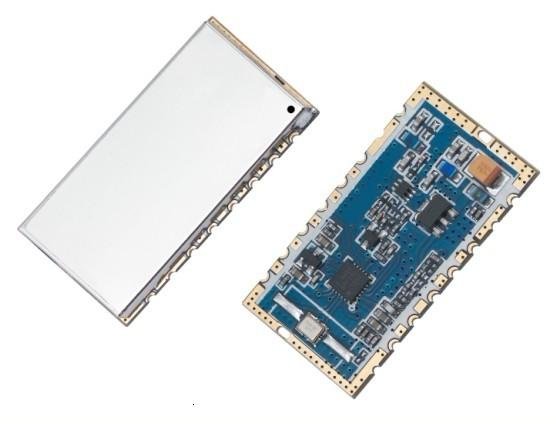
I have just come across a new product that might be interesting to all the PocketQube builders out there (or anyone who is interested in small RF links in general).
It is a new module from a company called "Nice RF" . This is different to HopeRF , so it seems that competition is alive and well in Shenzhen, China!
The module is the RF4463F30 .
If the part number looks familiar to those in the know, it is because it is based on the Silicon Labs Si4463 Wireless IC. The difference with this module is the F30 on the end of the part number....(Sorry, had to go there :-) ) Whereas the Si4463 is rated at +20dBm output, this module adds a power amplifier to boost the output to +30dBm! That's right, one whole watt! The module costs around $18USD, and is selling on AliExpress
Now HopeRF have a similar module , the RFM23BP, based on the Si4463's predecessor, the Si4432. This module can be purchased for around $9USD from places such as Anarduino
Remember, the Si4432 is the IC inside the venerable RFM22B, as used in $50Sat, which has now been continuously operating in space for more than 6 months! While the RFM22B has an output of +20dBm, the RFM23BP has an output of +30dBm. The RFM23BP also requires a 5V supply ( but supposedly works down to 3.3V)
To work out the differences between the RFM23BP and the RF4463F30, we'll need to dig into the datasheets. Now at the moment, the datasheet for the RF4463F30 is a little sparse, so I'll have to wait til my in-depth queries are answered by their tech support people. But on the surface, the differences are as follows:
Max Data Rate: 256kbps (RFM23BP), 1000kbps (RF4463F30)
Receive mode sensitivity: -120dBm (RFM23BP), -126dBm(RF4463F30)
Note the higher sensitivity of the RF4463F30 is based on a lower bit rate and smaller frequency deviation.
Receive mode current: 25mA (RFM23BP), 10-13.5mA (RF4463F30) - which seems to have 2 different sensitivity modes - High and Low
Transmit mode current (max power): 550mA (RFM23BP), 540mA (RF4463F30)
Size: 33mmx18mm(RFM23BP), 38mmx20mm(RF4463F30)
Now as the RF4463F30 is based on the Si4463, all the software commands that apply to the Si4463 can be used on the RF4463F30. Bearing in mind that 2 of the GPIO pins are used internally in the module for antenna switching functions.
So is this new module worth double the cost of the RFM23BP? Remembering we're talking about wireless modules that cost under $20 each, but it depends on your scenario. If you need to have (relatively) high power, both modules fit the bill, with similar power output and power usage. The newcomer seems to use less on the receive side, but if you want lower power usage for receiving, you may want to get the regular Si4463 module without the high power option, as the sensitivity is the same. The HopeRF module uses a register based firmware, whereas the Si4463 uses a new API approach.
I think some testing may be in order to really understand how the modules perform.
It is a new module from a company called "Nice RF" . This is different to HopeRF , so it seems that competition is alive and well in Shenzhen, China!
The module is the RF4463F30 .
Now HopeRF have a similar module , the RFM23BP, based on the Si4463's predecessor, the Si4432. This module can be purchased for around $9USD from places such as Anarduino
Remember, the Si4432 is the IC inside the venerable RFM22B, as used in $50Sat, which has now been continuously operating in space for more than 6 months! While the RFM22B has an output of +20dBm, the RFM23BP has an output of +30dBm. The RFM23BP also requires a 5V supply ( but supposedly works down to 3.3V)
To work out the differences between the RFM23BP and the RF4463F30, we'll need to dig into the datasheets. Now at the moment, the datasheet for the RF4463F30 is a little sparse, so I'll have to wait til my in-depth queries are answered by their tech support people. But on the surface, the differences are as follows:
Max Data Rate: 256kbps (RFM23BP), 1000kbps (RF4463F30)
Receive mode sensitivity: -120dBm (RFM23BP), -126dBm(RF4463F30)
Note the higher sensitivity of the RF4463F30 is based on a lower bit rate and smaller frequency deviation.
Receive mode current: 25mA (RFM23BP), 10-13.5mA (RF4463F30) - which seems to have 2 different sensitivity modes - High and Low
Transmit mode current (max power): 550mA (RFM23BP), 540mA (RF4463F30)
Size: 33mmx18mm(RFM23BP), 38mmx20mm(RF4463F30)
Now as the RF4463F30 is based on the Si4463, all the software commands that apply to the Si4463 can be used on the RF4463F30. Bearing in mind that 2 of the GPIO pins are used internally in the module for antenna switching functions.
So is this new module worth double the cost of the RFM23BP? Remembering we're talking about wireless modules that cost under $20 each, but it depends on your scenario. If you need to have (relatively) high power, both modules fit the bill, with similar power output and power usage. The newcomer seems to use less on the receive side, but if you want lower power usage for receiving, you may want to get the regular Si4463 module without the high power option, as the sensitivity is the same. The HopeRF module uses a register based firmware, whereas the Si4463 uses a new API approach.
I think some testing may be in order to really understand how the modules perform.
Other Modules
Looking at the NiceRF website, they have a few other modules that use either the Si4432 or the Si4463 Wireless IC's. Another of interest is the RF4432F27 . Looks like a +27dBm version of the RFM22B. Max TX current is 350mA @ 5V ( in case 500mA is too high)
They also have some test or demo boards with built-in Microcontroller and LCD.
All in all, it looks like there are now a few more options for ready made radio modules for PocketQube's!
Labels:
DIY Space,
HopeRF,
NiceRF,
PocketQube,
Radio
Monday, 3 February 2014
PocketQube Radio Ramblings
As PocketQube's are pretty new on the space scene, there isn't much in the way of COTS hardware available. You can now purchase the bus structures and ground integration jigs from PocketQube Shop , but it takes a few more components to get a fully functioning satellite!
One important area to consider is comms. How am I going to communicate with the satellite, and how is it going to communicate with the ground? For now I'll just talk about the space to ground segment hardware. I won't include discussions about licensing as that's for another time. The spacecraft is going to need a radio and an antenna, along with sufficient power to enable the signal to reach the ground.
Out of the 4 PQ "veterans" in space, at least 2 ($50Sat and T-LogoQube) are known to have used the HopeRF RFM22B radio module. This is a tiny 16x16mm RF tranceiver module, that is capable of +20dBm output (That's 100mW for those that haven't googled it yet), in the UHF frequency range. It is based on the Silicon Labs Si4432 Radio IC. Despite the seemingly limited power output, some of the data types can be detected almost horizon to horizon - approx 2900km range! Data packets can also be decoded at up to 900km with just a 10db gain Yagi and a LNA. Not bad for a sub $25 radio module!!!!!
Compare this to Cubesat Radio systems that cost well over $5000. GomSpace sell one for 8000 EUR with a 3W transmitter. Clyde-Space have one for $8600 , with 500mW to 2W RF output.
There's a thread on the DIYsats forum here about this and other HopeRF radio modules.
One important area to consider is comms. How am I going to communicate with the satellite, and how is it going to communicate with the ground? For now I'll just talk about the space to ground segment hardware. I won't include discussions about licensing as that's for another time. The spacecraft is going to need a radio and an antenna, along with sufficient power to enable the signal to reach the ground.
Out of the 4 PQ "veterans" in space, at least 2 ($50Sat and T-LogoQube) are known to have used the HopeRF RFM22B radio module. This is a tiny 16x16mm RF tranceiver module, that is capable of +20dBm output (That's 100mW for those that haven't googled it yet), in the UHF frequency range. It is based on the Silicon Labs Si4432 Radio IC. Despite the seemingly limited power output, some of the data types can be detected almost horizon to horizon - approx 2900km range! Data packets can also be decoded at up to 900km with just a 10db gain Yagi and a LNA. Not bad for a sub $25 radio module!!!!!
Compare this to Cubesat Radio systems that cost well over $5000. GomSpace sell one for 8000 EUR with a 3W transmitter. Clyde-Space have one for $8600 , with 500mW to 2W RF output.
There's a thread on the DIYsats forum here about this and other HopeRF radio modules.
So where to from here?
So the RFM22B is a proven performer for PocketQubes. Its low power requirements make it a good choice, but it does have some limitations. The data rate used by $50Sat is 1kbps. This is fine if your payload isn't very data intensive. But what are the alternatives? Here's a few areas I am looking into.
HopeRF make another module - RFM23BP. This is similar to the RFM22B, except the power output is 500mW. The higher power should allow higher data rates. The issue with this module is the higher electrical power requirements, which can affect how the PQ power subsystem is designed.
Still on the HopeRF parts list is the RFM69HCW. This module appears similar in specification to the RFM22B, but is based on the Silicon Labs Si4463 module. Now Silicon Labs state that the Si4432 shouldn't be used for new designs, although I don't think they intended their parts to be used in space! The Si4463/RFM69HCW uses an new API style approach to programming. While touted as being simpler and more efficient, testing from the $50Sat team has so far proved otherwise.
Silicon Labs also state that a low cost external FET can be used to boost the output to 27dBm/500mW.
Testing would need to be conducted to validate this approach.
Another HopeRF product is the RFM26W . While similar again, it is described as a device that "operates as a time division duplexing (TDD) transceiver where the device alternately transmits and receives data packets."
On to the RFM96W and the RFM98W. These are based on Semtech IC's, probably the SX1276 . These have the capability of using a patented LoRa modem, which can potentially increase the devices sensitivity, and therefore link budget. Further investigation is required as this ic has duty cycle limits, and whether the LoRa function works when the radio isn't configured for spread spectrum usage.
Then there's the HM-TRP. These are possibly most commonly used in the 3D Robotics Wireless Data Module. These also have 100mW/20dBm output, but operate as a simple transparent FSK transceiver - meaning that you just feed it UART data and it converts it to RF.
Another option could be to use a FEM ( Front End Module) in conjunction with the RFM22B. RFMD make a module - RFFM6403 . This is a 1W Power amplifier, but it can also operate in Bypass mode if required. It can also be a LNA for the receiver. This part is brand new and is available now in a reel, or later in March if you need single items. Definitely worth evaluating.
Other alternatives are pre-made modules from Radiometrix. They have some compact VHF / UHF transceivers. ( maybe not as cheap as $25 though).
Then there's 2.4ghz modules........ I haven't looked that far into this, but given my intention to use a USB SDR Dongle as a groundstation, that's out of their frequency range ( although I did find an interesting article recently using some cheap hardware as a down-converter. See here for info)
Conclusion
The only conclusion so far is that I really need to get my Amateur radio license and start doing some testing! I've purchased some of the HopeRF modules for testing, and have made the rookie mistake of buying the bare modules, sans breakout board. Half pitch pins don't fit in normal breadboards!
Fortunately bare breakout boards for the RFM22B are available from Modtronics in Australia. Others should take my advice and get populated boards such as those from Modtronics or from Sparkfun in USA.
As for the other modules, if you have any skills in KiCad, you can design a basic breakout and get the boards manufactured relatively cheaply from places such as Seeedstudio or Itead Studio.
I'll let you know how I get along!
Labels:
HopeRF,
PocketQube,
Radio
Subscribe to:
Posts (Atom)